Desolation Row Revisited

At midnight all the agents
And the superhuman crew
Come out and round up everyone
That knows more than they do
They bring them to the factory
Where the heart-attack machine
Is strapped across their shoulders
And then the kerosene
Is brought down from the castles
By insurance men who go
Check to see that nobody is escaping
To Desolation Row
Despite his reputation as a protest singer, if not the protest singer, I don’t think Bob Dylan was ever really political. This sharply distinguishes him from his early inspiration Woody Guthrie who wrote “This machine kills fascists” on his guitar. I don’t recall Dylan ever using the word “fascist”. He used the word “communist” and even featured it in a song. But he continually insisted that he didn’t know what this word meant. He was saying this as late as Scorsese’s No Direction Home.
Dylan’s gift was for impressionistic voyages that could really entrance, irrespective of the real life context. Which I suppose is what art does. Anti-Semitic tropes in Wagner have been discerned by many, though the issue is controversial. There’s enough ambiguity to fudge the issue. But even those who insist on the tropes would have to be foolish to deny the phenomenal power of Wagner’s music. Indeed, for them that’s the whole problem. Does the power of the music cause a dangerous “legitimisation” of the tropes?
This disjunction between the power of Dylan’s work and the “worthiness” of the subject matter came out later.
Take "Joey" from Desire. This huge lumbering dirge has an evocative wistfulness. Cf. the opening,
Born in Red Hook Brooklyn
In the year of who knows when
Opened up his eyes
To the sound of an accordion
Which is all very sweet ....until you realise the song’s inspiration is a vicious psychopath. [1]
And then there's the infamous "Neighbourhood Bully" from Infidels. The punchy lyrics of this powerful rocker are exhilarating.... until you realise it's an unhinged Zionist rant.
This connection between the impressive artistic product and the distasteful context is so much clearer in Dylan than in Wagner which makes Dylan more obviously problematic. If his output from the 60s still holds up it's due to the fact that his observations back then were indeed astute.
And this journey from, if you like, relevance to irrelevance is itself another indication as to why Dylan is a paradigmatic figure for the “baby boomer” generation.
But let’s start at the beginning.
Dylan wasn’t originally a “folkie”. He started out as a rock ‘n roll fan. He loved Elvis, Buddy Holly, Chuck Berry. Unfortunately he was born a little late to participate in this. By the time he was ready to go onstage, that first flash rock ‘n roll excitement was on the wane and the US was entering what Joni Mitchell referred to as “that dumb vanilla phase” i.e. a rehash of the old crooners with a slightly more up-tempo beat.
Dylan wasn’t interested. But that was the time he fortuitously stumbled on the folky stuff and what Greil Marcus referred to as “the old weird America”. And he also stumbled on Woody Guthrie via the latter’s autobiography Bound for Glory.
But the very title of that book signals what really drew Dylan i.e. not the politics but the bohemianism. It was the idea of jumping a freight train and reinventing yourself elsewhere. It was, ironically, the American Dream no less. [2]
Concerning the early phase of Dylan’s career, i.e. his “protest phase”, he “could say what everyone else wanted to say and he could say it better than anyone else knew how”. [3] He had this terrific ability to “tune in”.
And this sensitivity to the zeitgeist allied to an astonishing ability to spin out these wondrous words led to a deepening perception which was indeed astute. “Blowing in the Wind” may still be his most famous song. And it’s a remarkable piece that had the feel of some old traditional chant. Dylan himself said he couldn’t believe it was his own creation. But for all its evocative quality it was a vague expression of a kind of helpless wonderment at the sheer awfulness of it all.
“Only A Pawn in Their Game” is a bolder statement. It relates the tale of a black killed by a white. But instead of “pointing the finger” at the white killer, it regards him as another kind of victim, as someone who is “played” from above “to keep up his hate so he never thinks straight”.
That was from Dylan’s third album – the peak of his “protest” period when he was paired with Joan Baez and getting involved in civil rights marches. They performed at the March on Washington for Jobs and Freedom in Washington in August, 1963. Shortly before that, JFK had delivered his civil rights speech which proposed legislation that would later become the Civil Rights Act. JFK was assassinated in November of that year.
“Beatlemania” started to heat up in the States in early ’64 signalling that Dylan’s first love, rock ‘n roll, was back. In the summer of that year, Dylan released the significantly titled Another Side of Bob Dylan. This featured songs which were a total departure from the protest model – a model that was explicitly rejected in a song with another significant title, “My Back Pages”.
Thus Dylan began to move away from direct political involvement. He also moved away from the acoustic folkie stuff towards a more rock oriented sound, first implicitly with Another Side, then he had a trial rock run with the half electric Bringing it All Back Home, and then he dived in all the way with Highway 61 Revisited.
His distancing from politics was echoed in an increasingly facetious attitude[3]. This switch away from folk music and from politics upset a lot of people, not least Baez and the fan who shouted “Judas!” at a UK concert which has now acquired legendary status.
There seems to be a general critical consensus that Dylan became a “much greater artist” when he abandoned direct participation in, or direct reference to, politics. But this view seems to imply that politics isn’t a suitable topic for “worthy” art.
Another critical gambit is to suggest that politics is “much bigger” than politics i.e. that there are other types of politics that are more “profound”. Certainly there are aspects to politics that go beyond formal politics. This is particularly true of a capitalist society in which power has generally moved out of direct rule and into the economic sphere.
But I would say that, in retrospect, this move to “a different type of politics” for Dylan amounted to a retreat. Writing about the Another Side album, Michael Gray wrote,
This was years before any of us understood that ‘love’ and politics weren’t opposites – that there was such a thing as sexual politics.
I read Gray’s comment in the early 80s and thought, “Yeah right on!”. Four decades later, faced with identity politics and something called “transgender people” who are being likened to Holocaust victims, Gray's remark sounds like the opening of a long and bitter joke. In retrospect Dylan’s “de-politicization” seems to parallel a similar retreat in the critical apparatus around him.
But to return to Highway 61, first note that this album was released in August 1965. Malcolm X had been assassinated six months earlier. Highway 61 contains “Desolation Row”.
I consider “Desolation Row” to be Dylan’s masterpiece and the most perceptive political song I’ve heard. It describes our society as a vast carnival which we are all encouraged to join or at least view. Sinister figures patrol the periphery to ensure that no-one leaves the show, no-one wanders off. Those who do meet a nasty end via “the heart attack machine”. Desolation Row itself exists outside the carnival and is a place from which the truth can be seen. It is a place that the carnival’s guardians don’t want you to go to.
In the light of this dark vision, Dylan’s actions and the general events around this time merit closer consideration.
To recap, by the time of this album, there had been two assassinations – each involving figures associated with the civil rights movement. The assassinations of Robert Kennedy and Martin Luther King would follow in 1968 but of course Dylan couldn’t know that. Nevertheless by the time of the album’s release, it was clear that something wicked was this way coming and indeed had pretty much arrived.
Dylan himself had associations with the civil rights movement. He was viewed as a “protest figure”, a role he was clearly trying to disassociate himself from. He attracted a vast audience who saw themselves as participating in the “counter culture”. He was performing in front of large numbers. And, yes, he was on drugs a lot of the time.
Consider also Dylan’s 2020 track “Murder Most Foul” which refers to the JFK assassination as the “(g)reatest magic trick ever under the sun, perfectly executed, skillfully done” in which “they blew off his head when he was still in the car”. Note the “they”.
I would say that in 1965 Dylan was scared and who would blame him? “Desolation Row” is a brilliant explication of his political view disguised metaphorically.
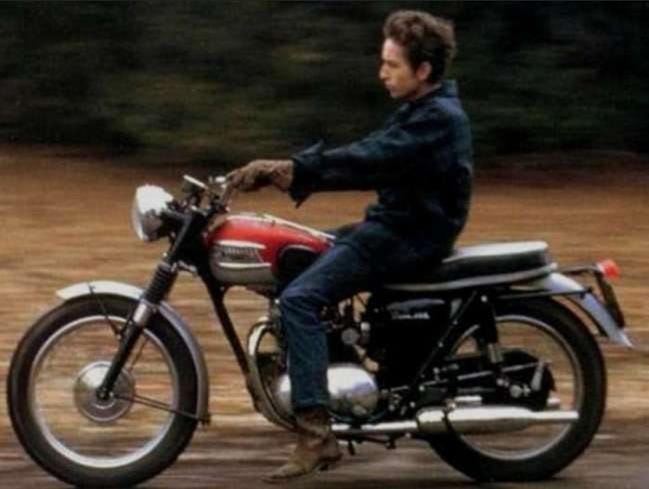
Not long after that he had a “motor cycle accident”. Or that at least is what was claimed. See the following,
There are, however, reasons for doubting the truth of this story (mainly the desultory way in which information filtered through)
https://www.geocities.ws/mytoprock/dylan.html
And,
The crash near Woodstock, NY, remains steeped in mystery and speculation. Officially, Dylan suffered neck injuries, breaking several vertebrae, but no ambulance or hospital visit was documented, fueling rumors.
https://www.reddit.com/r/bobdylan/comments/1i4nrl6/what_is_the_real_truth_behind_bob_dylans_july/
After a period of convalescence, Dylan released John Wesley Harding, an album with a “countrified” feel and full of religious imagery. This was initially interpreted as Dylan “getting the faith” but the aforementioned Michal Gray has a brilliant deconstruction of the title track showing it to be deliberately empty and thus deeply critical of the Western Hero myth. And in a brilliant and now sadly unavailable book (Voice Without Restraint), John Herdsman has talked of the almost sinister evasiveness of the whole album.
After this came Dylan’s first full on country album and a general retreat from topicality. He still released brilliant stuff over the remaining years but kept aloof from direct participation in politics. As for “Murder Most Foul”, well perhaps he now feels it’s safe enough to come out and say it. And it’s interesting how the media predictably reacted by totally evading the accusation of conspiracy and spoke with its usual cynical pseudo profound vacuity about “the myths of our past” etc.
Nowadays pop stars are all “rebels” and “dissidents” but of course only under strict “house rules”. None of them are a real threat.
As an addendum, I think we can introduce two other figures:
First, Mick Jagger who did have a certain political aura but one that was always thoroughly covered in cynicism. “What can a poor boy do/ ‘Cept to sing for a rock and roll band” was his way out. Although with “Undercover of the Night”, he made a video which depicted an assassination carried out in South America. Jagger appeared on a late night show to talk about it. The video was shown but when it reached the violent bit, the camera suddenly switched to a startled Jagger sitting in the studio. He complained about censorship but probably thought “Why did I bother?” After which he returned to his previous cynicism.
Second, John Lennon ... and we all know what happened to him. My interpretation is that Lennon had one thing that neither Dylan nor Jagger had: naiveté. He said “Power to the People” and wanted to “Give Peace a Chance”. For all his anger he never descended to cynicism. And that’s what made him dangerous.
*
[1] https://www.villagevoice.com/dylan-dallies-with-mafia-chic-joey-gallo-was-no-hero/
[2] Admittedly, these issues are never straightforward. After all, the bohemian dream is linked to politics. Wasn’t Marx concerned with making a better world? Wasn’t Marx also a dreamer? He was – but he had a powerfully analytical mind.
[3] Unfortunately I can’t find the source for this quote. But I clearly recall someone saying it.
When asked what he – “The Spokesman of a Generation” – would do if he were to be drafted, his answer was sober and honest, “I’d probably just do what had to be done.”
This was followed by a question asking if he would be participating in the Viwtnam Day Committ demonstration that night. Dylan answered with a smirk, “No. I’ll be busy tonight.”
Your analysis of Desolation Row as the escape from the funhouse corresponds with your choice of Substack title, Goblins Under the Apple Tree taken from the last line of the Ray Bradbury quote that describes America after WWII as a funhouse that no one is allowed to leave.
I remember being 12 years old and sitting in the upstairs bedroom in our old forest green creaky wooden house in Long Beach, California, listening to those first Dylan records on my little record player, over and over and never getting tired of listening---the images those songs evoked changed each listen. Dylan’s cryptic style forced us to think, but most interpretations missed the mark. He once said something to the effect “People can learn everything about my songs except what they are about.” As the songs and we aged, we began to see them differently. Maybe not the songs as much as the world.
In Chronicles: Volume One, Dylan described his peak writing years as almost supernatural, saying the songs “came to me like a ghost. It was like they were written in the air.” But later, he admitted he couldn’t do that anymore. His ideas he said came from “the box,” maybe a reference to his propensity for writing down and storing random thoughts that could be accessed later—reminding me of William Burroughs’ cut-up method that influenced artists like Bowie.
By the time Murder Most Foul was released, questioning the official JFK assassination wasn’t exactly groundbreaking. Since then, we'd had the inside job of 911 with the Patriot Act waiting in the wings that beefed up mass surveillance, a million Iraqis murdered over non-existent WMDs, continued genocide in Palestine and the fake pandemic.
When the promotion for Dylan’s 2020 album with Murder Most Foul came out, it featured a tuxedo-wearing skeleton holding a large syringe. I thought Dylan might actually have something to say about the lockdowns and Operation Warp Speed, but nothing. Instead, he sings about the Kennedy assassination. Maybe if he lives another 10 years he may take on the scamdemic.
Dylan has admitted that he got ideas for songs from reading the newspaper; Hattie Carrol, Hollis Brown, Hurricane Carter, Joey Gallo. I went back and listened to the song Joey today and when I got to these lines:
“One day they blew him down in a clam bar in New York.
He could see it coming through the door as he lifted up his fork”
I was reminded of the final scene in The Sopranos, where Tony is sitting in an Italian restaurant with his family facing the front, the bell on the door rings as it opens and he raises his eyes …… fade to black.
During her induction into the Rock and Roll Hall of Fame in 2015, Joan Jett said:
“Rock and roll is political. It is a meaningful way to express dissent, upset the status quo, stir up revolution, and fight for human rights. Think I’m making it sound more important and serious than it is? “It’s only rock and roll,” right? Rock and roll is an idea, and an ideal…There are Pussy Riots wherever there is political agitation.”
Let’s not forget Madonna is selling 100 percent cotton Pussy Riot-shirts for $19.99.
Nothing revolutionary survives under capitalism without being absorbed, sanitized, or rendered harmless. Once it gains enough traction it gets co-opted, commodified, turned into a brand…or erased. Not that Pussy Riot is revolutionary.
Pete Seeger once said, “No song I can sing will make Governor Wallace change his mind.”
I have difficulty accepting that John Lennon was considered dangerous to the power structure. America is paranoid and J. Edgar Hoover very paranoid; he had reports and files on everyone. But by 1975, Nixon had resigned and Lennon had withdrawn from any hint of activism, settling into his life as a wealthy musician, stay-at-home dad, and Yoko’s business partner. If there was ever a time when the U.S. government saw him as a “problem,” it had long passed by 1980.
He was more reactionary than revolutionary. The song Revolution was vaguely anti-communist. Even Power to the People wasn’t calling for revolution—just an undefined populist uprising. His activism was performative at best—and capitalism had no problem absorbing it, repackaging it, and selling it back to his adoring public.
The bed-ins for peace were more publicity stunt than protest. Instead of organizing direct action, boycotts, or economic resistance, Lennon and Yoko, a Japanese woman with the means to be badly avant-garde, who also pretty much controlled every aspect of John’s life, sat in a hotel bed and invited the press. The media ate it up, but it didn’t challenge capitalism, imperialism or even the war machine in any meaningful way.
Plus, who wants to listen to a multi-millionaire who owns the entire penthouse floor of NYC’s Dakota sing about imagining no possessions, it’s easy if you try. (Although I admit it was a very popular song among middle-class white kids—and later became the go-to soundtrack for luxury car commercials YIKES! and corporate branding exercises in faux idealism.)
Sounds like something out of the World Economic Forum, “in the future you will own nothing and you will be happy” But someone WILL own everything and rent it back to you and feed you SSRIs so your rentier-class status will be easier to swallow.
Yes, I too am old and sad…born in 1950, and very cynical.
I just remembered something I read. After Lennon was murdered, Yoko auctioned off anything of John’s she could and laughed about it all the way to the bank. She even made John’s disinherited first son buy at auction letters he had written his father. After Yoko refused to give them to him, she sold them and he had to purchase them from a memorabilia dealer at a mark-up.
Yet, I’d trade even the commercialized music of my youth for what passes for it today.
“The Nobel should’ve gone to Nina Simone,” my daughter declared back in 2016. Thanks for this post.