The Inward Movement

Run for cover!
Even the most euphoric of flowerchildren were beginning both to need and fear their solitude, and to feel the strain of artificially imposed selflessness. The time was ripe for reactionary expressions of frustration, confusion, irony, quiet little confidences and personal declarations of independence.
-Janet Maslin, “Singer/Songwriters”, The Rolling Stone Illustrated History of Rock & Roll
Nothing comes out of that voice that sounds anything at all like faith. Rather it communicates a strong sense of the reality of evil: but in a much less direct way than the Rolling Stones’ more or less contemporary “Sympathy for the Devil” from their album Beggar’s Banquet.
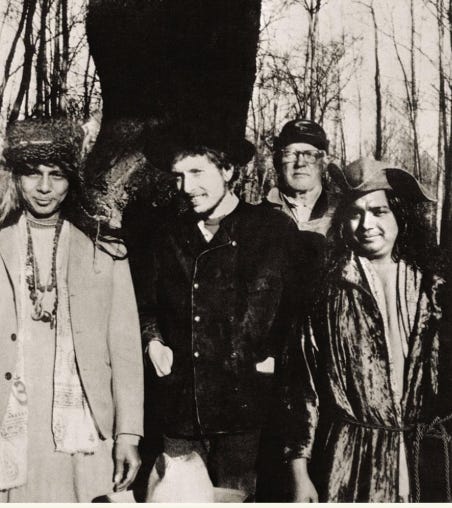
The dominant atmosphere of John Wesley Harding is of hollowness, emptiness, vagueness, insubstantiality; at moments it impresses the listener almost like the onset of a sickness. This mood of spiritual greyness, of failed aspirations, is pervasive and certainly intended, and it is not transmitted only through Dylan’s voice and its spare musical backing – even the cover reflects it.
-John Herdsman, Voice Without Restraint
*
Disclaimer: Some of the judgements I pass on various pieces of music and musicians will probably provoke ire. Well, this is my interpretation. Also, I don’t mean to be mean to the people I’m describing here. Their reaction to circumstances is perfectly understandable and, furthermore, as a miserable Scot, I am even impressed!
*
In my last post I noted how the revolutionary movements of the early 20th Century were derailed by a repackaging of Marxism compliant with Western capitalist interests. I noted that part of this transformational project aimed at redirecting attention towards an individualist psychoanalytical framework. And whilst I was telling the story, it seemed familiar to me. I then recalled that it had a later echo in the transition from the 60s to the 70s. This is a transition hinted at in the quotes heading this post. The path was from engagement to self-absorption, this focus on the self sometimes accompanied by religious themes. The religious aspect is not necessarily all negative as I hope to explain.
For someone like myself, born after 1960 (in my case, only just at ‘61!), it’s second nature to think of the music industry as harbouring “radical” figures. But it’s quite an imaginative leap to try to project yourself back to the pre-60s frame.
It’s certainly not the case that “protest” music began in the 60s. Bob Dylan’s hero Woody Guthrie was a dissident figure with “This machine kills fascists” labelled on his guitar. The astonishing anti-racist “Strange Fruit” sung by Billie Holiday was written as far back as 1939. Indeed, US protest songs alone go back to the 18th century. And, coming up to date, protest music was represented in the pre-rock world by such figures as Guthrie and Paul Robeson.
But the whole youth movement that began with the rising affluence in the 50s and its new genre of “Rock & Roll” was a decisive stepping stone towards the much more mass-orientated and centralised media of today. As far as I’m aware, early R&R was apolitical, the first widely available protest songs coming in the 60s with Dylan. And the protest mode really caught on when Dylan went electric.
Dylan serves as a central paradigmatic figure here – and indeed even a prophetic one. Although this is a problematic case partly because, ironically, I don’t think he was ever fully attuned to politics and always had a religious temperament. Since there’s no point in reinventing the wheel, I include here my comments from an earlier post. First a general comment on Dylan:
Despite his reputation as a protest singer, if not the protest singer, I don’t think Bob Dylan was ever really political. This sharply distinguishes him from his early inspiration Woody Guthrie who wrote “This machine kills fascists” on his guitar. I don’t recall Dylan ever using the word “fascist”. He used the word “communist” and even featured it in a song. But he continually insisted that he didn’t know what this word meant. He was saying this as late as Scorsese’s No Direction Home.
This on his astonishing song “Desolation Row”:
I consider “Desolation Row” to be Dylan’s masterpiece and the most perceptive political song I’ve heard. It describes our society as a vast carnival which we are all encouraged to join or at least view. Sinister figures patrol the periphery to ensure that no-one leaves the show, no-one wanders off. Those who do meet a nasty end via “the heart attack machine”. Desolation Row itself exists outside the carnival and is a place from which the truth can be seen. It is a place that the carnival’s guardians don’t want you to go to.
And this on the time of the album that contains the song, Highway 61 Revisited:
… by the time of this album, there had been two assassinations – each involving figures associated with the civil rights movement. The assassinations of Robert Kennedy and Martin Luther King would follow in 1968 but of course Dylan couldn’t know that. Nevertheless, by the time of the album’s release, it was clear that something wicked was this way coming and indeed had pretty much arrived.
Dylan himself had associations with the civil rights movement. He was viewed as a “protest figure”, a role he was clearly trying to disassociate himself from. He attracted a vast audience who saw themselves as participating in the “counter culture”. He was performing in front of large numbers. And, yes, he was on drugs a lot of the time.
Quotes from https://georgemc189059.substack.com/p/desolation-row-revisisted
I think it’s hardly paranoid, and not even that controversial, to muse on the increasing surveillance and encroaching security apparatus around a popular music that was considered increasingly troublesome, especially in its usage by both the civil rights movement and the anti-war movement. The most threatening issue here was, as always, the prospect of a mass movement arising.
This was further complicated by intrusions into the protest movement by co-optation and assimilation. The late Dave McGowan’s Weird Scenes Inside the Canyon has richly detailed speculation on this.
Dylan was clearly well aware of the precarious position he was in and in many ways had, as it were, already “prepared his escape” as far back as his fourth album which was unsubtly titled Another Side of Bob Dylan. This wasn’t entirely some kind of shrewd self-protective move since he was already feeling stifled by what he referred to as “finger pointing songs”. And here we have one of those curious conundrums in that his “retreat” from the protest genre inspired songs that were actually more politically astute than the earlier confrontational pieces, culminating in the magisterial “Desolation Row”.
Not that deepening insight and greater nuance mattered at all to the sinister forces gathering around him and he knew something more decisive was needed. His “way out” was to “report in sick” via a convenient motor cycle accident. And after a period of “convalescence”, he appeared with the album John Wesley Harding which John Herdsman speaks of above.
JWH is one of the strangest albums. First off, it has neither the profusion nor the specificity of his earlier material. It’s a stripped-down set with a style that would later contribute to the genre of “country rock”. There is a religious feel which many took to be a matter of straightforward sincerity. Herdsman realised that something quite different was afoot.
The aura of the album conjures up a chilly atmosphere of a dreamlike barren landscape lit by a wan sun that seems to be on the verge of twilight but there is an ambiguity about the celestial body’s movement. Is it rising in the wee small hours or setting at the end of day?
Michael Gray has noted that the title track at first impresses as yet another hero ballad but on closer inspection is determinedly non-committal in all its claims. As Gray sinisterly observes about the claim made on behalf of Harding, this “friend to the poor”:
It refrains from contradicting the suspicion that Harding’s name could be added to a long list of men whose lives and interests are spent in opposition, effectively, to the lives and interests of the poor but to whom it is advantageous to seem to appeal.
-Michael Gray, Song & Dance Man III: The Art of Bob Dylan
The album continues with curious dreamlike vignettes which are unsettling for their very air of a skeletal deprivation. Their tendency towards concision marks them out as a departure from his earlier material. And yet it is that compactness that is eerie since it highlights the lacunae. The album seems to be telling us that the days of plentiful optimism are over and we are left with an encroaching hangover and a sense we have not only been swindled but were deceived all along.
Thus, JWH is an album that is no longer merely opting out of any political movement but is calling all such movements into question and indeed abandoning them for a denuded landscape in which nothing is as it seems. And it is hardly surprising that the only two songs from the album which continued to be performed and even covered are “All Along the Watch Tower” with its ferocious “in your face” apocalypse, and “I’ll Be Your Baby Tonight” coming from the opposite extreme of complacent sensual enjoyment.
And it is revealing that these are the two modes that seem to dominate rock music from then on i.e. either the frisson of a self-aggrandizing prophecy of impending Armageddon … or the more common call to just forget it all and fornicate. The very title “I’ll be Your Baby Tonight” suggests regression to infantilism.
Thus, I think that JWH is a crucial document of a “turning of the tide” moment – Dylan’s effective “resignation” from the protest movement.
The other practitioners followed. The celebrated Woodstock concert came two years after JWH and was followed in a matter of months by the disastrous Altamont concert in which a young African American was clubbed to death. This is the sour note on which the 60s ended.
The 70s initially became the decade of the “singer/songwriter” as catalogued in the Janet Maslin article quoted above. The prevailing mood was of political defeatism and introspection, the cult of the self-absorbed individual. A perfectly understandable phenomenon, all the more so when you consider that many of the 60s stars who were about to “go larger” probably never felt comfortable with the political posturing anyway. I cite a few examples.
Paul
Paul Simon was always a fastidious craftsman more engaged with personal issues than political ones. He has also been one of the most musically sophisticated artists who nevertheless has managed to avoid pretentiousness. His early arrangement of “Scarborough Fair” uses a delicate rhythmic ambiguity that flummoxed me as a kid. The technical term is “hemiola”. Simon’s fastidiousness wasn’t acquired. His first album, The Paul Simon Songbook, which predates Simon & Garfunkel, has liner notes so paranoid that they read like an LSD trip filtered through Philip K Dick. I admit that I have found a certain tweeness to some of his material. But everything he does has a thoroughly premeditated quality and is presumably what he was aiming for. [1] It has sometimes struck me that he might have been happier being born into a pre-rock time.
Joni
Simon’s musical sophistication is echoed in Joni Mitchell who likewise never seemed to fit a “protest mode”. She distanced herself from the anti-war movement by declaring her support for “our boys overseas” although she critiqued the Vietnam War with her “Fiddle and the Drum”. She also penned the song “Woodstock”, widely considered the ultimate tribute to the concert, despite not attending the event. In a way it is perfectly fitting with its vague sentiment about “getting back to the garden”. Her later Hissing of Summer Lawns is a dense piece with, at least partly, an acidic commentary on bourgeois complacency which seems to occupy the same stifling urban milieu as with Roxy Music (cf. “In Every Dream Home a Heartache”). She rages against the undeniable slump in cultural awareness, sometimes amusingly as with this reaction to the Madonna influence:
What would I do? Show my tits? Grab my crotch? Get hair extensions and a choreographer? It’s not my world.
Incidentally, one of the more annoying “rock critics” (a rich field!), Robert Christgau, passed this judgement on Joni’s Chalk Mark in a Rain Storm:
Dreaming, fabulizing, playing the ingenue, speaking for the displaced Native American, preaching about materialism and ecocatastrophe and the engines of war (and abortion, though not so’s you can tell where she stands), she’s matured into a sententious liberal. Give me the Poet of the Me Decade any day. At least Joan Baez is a sententious radical.
That would be the same “radical” Baez who ended up painting an adoring tribute to Anthony Fauci which she had the nerve to list under a group she calls “Mischief Makers”. Ah how the self-styled rebels of the 60s love to exalt their “subversion” whilst comfortably ensconced within the mainstream.
Leonard
It ought to be recalled that Leonard Cohen was older than the others considered here. As Maslin notes, he did much of his growing up in private. Also, he evinced a curious take on the singer/songwriter genre. As Maslin writes:
…Cohen presented a unique combat strategy, since he had no special eagerness to win the battle, and he knew how to make the most out of defeat.
He’s practically a Scot! Well, you wouldn’t expect such a person to be storming the barricades although he has indeed given us some politically astute commentaries, including the following which is pretty much an open admission of the failure of boomer aspirations:
Everybody knows that the dice are loaded
Everybody rolls with their fingers crossed
Everybody knows the war is over
Everybody knows the good guys lost
Everybody knows the fight was fixed
The poor stay poor, the rich get rich
That’s how it goes
Everybody knows
Neil
I consider Neil Young to be one of the finest of all songwriters. He has the gift of evocative simplicity. “He came dancing across the water with his galleons and guns”. That kind of thing.
But here’s a thing. I was in a charity shop recently and caught a blast of his “Rockin’ In The Free World”:
I see a woman in the night with a baby in her hand
Under an old street light near a garbage can
Now she puts the kid away and she’s gone to get a hit
She hates her life and what she’s done to it
There’s one more kid that will never go to school
Never get to fall in love, never get to be cool
He snarls out the lyric. And there’s still enough of an adolescent in me to think, “Damned straight, Neil! Tell it like it is! Stick it to these rich bastards!” But then I figured that this is the kind of “protest” thing I’ve been hearing all my life. And it’s made zero difference. And the system operators know this well. Indeed, the angry pose helps sell records whilst providing evidence of how “free” we all are. We get to sneer at the system whilst feeding into the system.
All of which flows naturally from the “Faustian Deal” made by the rockers at the end of the 60s. Knowing very well that there will never be any chance of them forming any kind of mass solidarity that will have a political effect, the system made them an implicit proposal: You get to keep your rebel credentials and the leather jacket and the jeans and the punky pose … but just know that it’s over and all that rebel glamour will just keep the cash registers ringing.
Ah but what about that tantalising bit I voiced about the religious angle? Well, as someone as jaded as myself about the (im)possibility of achieving any sizable solidarity in this ferociously atomised age, I acknowledge that there is a power still adherent in the religious sentiment. And yes, I know all about corrupted religious movements too. But it’s interesting that this post-covid “Left” turn has instinctively homed in on the demonisation of religion. And I speak as a non-religious person here. But I am aware that there is a collectivization inherent in religion that seems more powerful than with many other modes of life. And it’s interesting that that emphasised word there, i.e. collectivization, has itself been so demonised too.
Will Jesus be the world’s salvation? Or one of those other ones? Probably not. But I note that religion can still pull (some) people together more effectively than most of the Leftist rhetoric which, welded to various strident gesticulators and gasbags, seems to be as bent on merely securing a glamourous personal pose as the sound of the aforementioned post-60s rock stars.
*
[1] There is a story that Simon reacted with extreme negativity to “Desolation Row” when someone told him he was just jealous because he could never have written it. This caused him to fly into a rage. Protesting too much?
Labels like "protest singer" are just marketing tools for record companies. Music and art are meant to be experienced, not categorized. I understand your point about that "rebellious feeling"...that it’s an emotional substitute that often stands in for actual rebellion. Today, however, that feeling has mostly been replaced by a pervasive vapidness.But it wasn’t just that the 60s generation fell for a bait-and-switch. Many were genuinely turning away from the machine to experiment with new ways of living.
The Western Left often argues that those who went back to the land were "copping out" and handing a gift to the rulers by abandoning the fight in the streets. I’d argue the opposite: the system handles street fighting far better than it handles people who throw away their TVs, stop buying commodities, and quit the 9-to-5 grind to wean themselves off the corporate teat.
Unfortunately, those in power play a long game. All the system had to do was wait for the next generation while continuing to enclose the commons. By the 70s, the "iron fist" arrived with the most rapid buildup of the prison system in American history. Radicals who weren't killed were caged, as were the back-to-the-landers busted by CAMP for growing the very plants they used to fund their independence.